Rasel, Policy Committee Call for Unleashing Pennsylvania Energy to Lower Costs, Strengthen Reliability
September 16, 2026
NORTH HUNTINGDON— Pennsylvania has the resources needed to deliver affordable, reliable energy, but regulatory barriers and misguided policies are preventing the Commonwealth from realizing its full potential, according to testimony presented Monday before the House Republican Policy Committee.
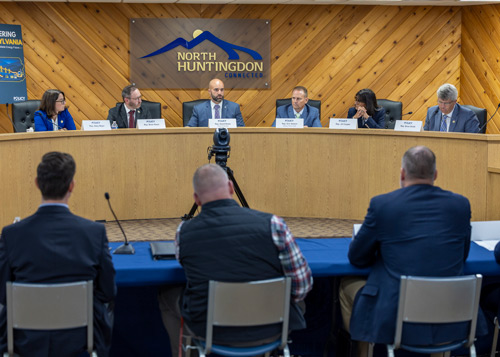
The hearing, titled “Powering Pennsylvania: An Affordable, Reliable Energy Future,” was hosted by Rep. Brian Rasel (R-Westmoreland) and chaired by House Republican Policy Committee Chairman David H. Rowe (R-Snyder/Union/Mifflin/Juniata).
Testifiers included Matt Mackowiak, director, government affairs, Core Natural Resources; Patrick Henderson, vice president, government affairs and communications, Marcellus Shale Coalition; John Otto, executive director, Citizens Energy Council; and Nick Kerin, deputy state director, Americans for Prosperity – PA.
“While poor policy decisions, some going back many years ago, continue to drive up energy costs, Pennsylvania residents continue to be bogged down with inflated power bills and questions as to whether our energy infrastructure is dependable and capable to meet our future needs,” Rasel said. “Hearings like this are important not only to help legislators craft better policies, but to provide transparency to the public as to the real inflationary costs driven by their own government. Affordable, reliable energy shouldn’t be a question in a resource-rich environment like Pennsylvania.”
Mackowiak testified that Pennsylvania’s declining supply of baseload generation is contributing to rising electricity prices at a time when demand is rapidly increasing. He noted that Pennsylvania is the nation’s third-largest coal producer, yet many of the coal-fired plants that once supplied reliable electricity have been retired and demolished.
“In summary, higher energy demand and lower supply means increases in power prices,” Mackowiak said. “For Pennsylvanians, dramatic increases in power bills means not being able to put gas in the car. It means less money for groceries. It means the choice between heating your home or going without basic medical care.”
“Baseload power must be protected and expanded where possible,” he continued. “We can't afford to continue losing reliable energy sources, and Pennsylvanians can't afford higher electricity prices as a result.”
Henderson highlighted the benefits Pennsylvania consumers have received from the development of the Marcellus Shale. He testified that Pennsylvania has gone from importing 75% of its natural gas to producing nearly 20% of the nation’s supply, helping to reduce natural gas utility supply costs by between 50% and 74% since 2008.
“We need leadership from the governor to build infrastructure, both natural gas pipelines and electric transmission,” Henderson said. “We urge you to say no to new taxes, be it on power generation or energy production. New taxes are simply taxes on consumers.”
Otto outlined the direct benefits energy development provides to communities in Westmoreland County, including more than $24 million in natural gas impact fee revenue distributed to local municipalities since 2011. He said the revenue supports roads, bridges, emergency services, water and sewer systems, parks, and farmland preservation.
“Let's face it, prices are up, people's bills are up. Here's why. Quite simply, demand is growing faster than supply,” Otto said. “And the answer to that problem is sitting right below us.”
Otto also pushed back against the idea that policymakers must choose between developing energy and protecting the environment.
“It seems as though the environmental activists would like us to believe that you have to pick energy or the environment,” Otto said. “And the reality of it is energy and environment can coexist.”
Kerin warned that Pennsylvania is competing with neighboring states for energy development, manufacturing projects, jobs and private investment. He recommended firm permitting deadlines, greater regulatory predictability and policies that allow large energy users to finance generation needed to support their own operations.
“You cannot say Pennsylvania is open for business while making businesses wait indefinitely for the permission to build,” Kerin said.
Kerin also stressed that Pennsylvania must protect its residents from being forced to subsidize costs created by other states within the PJM Interconnection.
“Pennsylvania can be the powerhouse of the Mid-Atlantic. We should not just become its blank check,” Kerin said. “Let's make Pennsylvania the easiest place in PJM to build the next megawatt and the hardest place to stick families with somebody else's bill.”
Rowe said higher energy costs reach far beyond monthly utility bills, raising the cost of food, transportation, manufacturing and nearly every product or service Pennsylvanians purchase.
“We have energy resources to deliver affordability and reliability, but families are still paying higher bills, and warnings about the reliability of our grid continue to grow louder,” Rowe said. “These are the consequences of policies that obstruct production, delay projects, and leave consumers to pay the price.”
“Simply put, enough is enough,” Rowe continued. “It's time to unleash our energy supply, produce more power, and put Pennsylvanians first.”
Rasel concluded that Pennsylvania’s energy policies have real consequences for families struggling to afford basic necessities.
“There's absolutely no reason in Pennsylvania that a widow should have to choose between paying a medical bill or keeping her lights on,” Rasel said. “There's no reason that a mother or a father should have to choose between keeping their home warm or feeding their children.”
The full hearing can be viewed here: youtube.com/@pahousegop.
Representative David H. Rowe
85th Legislative District
Pennsylvania House of Representatives
Media Contact: Nancy Nilson
nnilson@pahousegop.com
www.policycommittee.com